Um espaço para partilha de ideias relacionadas com as práticas artísticas
e os seus efeitos terapêuticos, com destaque para a vertente musical

sexta-feira, 31 de outubro de 2014

Childhood depression maybe cured by music therapy

In the largest ever research of its kind, the scientists have found that music therapy can be a possible cure for depression in children and adolescents having behavioural and emotional troubles.

The study, conducted by the researchers at Queen’s University Belfast along with the Northern Ireland Music Therapy Trust, found that children or teens who received the music therapy treatment showed remarkable improvements in their self-esteem and also reduced their depression symptoms significantly as compared to those who were deprived of the music therapy treatment.

During the study, the researchers also found that those depressed kids who received music therapy had also improved their communicative and interactive skills as compared to those who received usual care options alone.


The research work was conducted between the period March 2011 and May 2014 and involved 251 children and young people who were divided into two groups. The first group included 128 people who were given the usual care options and the second one that involved 123 participants who were also getting an additional music therapy treatment along with the usual care.

All the participants were getting treatment for the emotional, developmental and behavioural problems. The early findings suggested towards the benefits of music therapy that are sustained in the long term.

Dr Valerie Holmes, Centre for Public Health, School of Medicine, Dentistry and Biomedical Sciences and co-researcher, “This is the largest study ever to be carried out looking at music therapy’s ability to help this very vulnerable group, and is further evidence of how Queen’s University is advancing knowledge and changing lives.”

Ciara Reilly, Chief Executive of the Northern Ireland Music Therapy Trust, said, “Music therapy has often been used with children and young people with particular mental health needs, but this is the first time its effectiveness has been shown by a definitive randomized controlled trial in a clinical setting.”

Concluding the study, Reilly said that the findings are dramatic and underline the requirement for music therapy as a mainstream treatment option for the patients suffering from the stress and depression problems.

Written by James Kent at Wall Street OTC 

segunda-feira, 13 de outubro de 2014

How playing an INSTRUMENT benefits your BRAIN

When you listen to music, multiple areas of your brain become engaged and active. But when you actually play an instrument, that activity becomes more like a full-body brain workout. 


What’s going on? Anita Collins explains the fireworks that go off in musicians’ brains when they play, and examines some of the long-term positive effects of this mental workout.


quinta-feira, 9 de outubro de 2014

Music has the power to heal

There is an old belief, now being revisited, that music has the power to heal. Where does this idea come from, and how does it apply to traditional Chinese music?
"Our ancestors believed that music had the power to harmonize a person’s soul in ways that medicine could not. In ancient China, one of music’s earliest purposes was for healing. The Chinese word, or character, for medicine actually comes from the character for music.
During the time of the Great Yellow Emperor (2698-2598 B.C.E.), people discovered the relationship between the pentatonic scale, the five elements, and the health five internal and five sensory organs. During Confucius time, scholars used music’s calming properties to improve strengthen people’s character and conduct. 
Today, scientific research has also validated music’s therapeutic ability to lower blood pressure, reduce anxiety, enhance concentration, stabilize heart rate, and more."
 Gao Yuan 


You can find the whole interview with Shen Yun Symphony Orchestra Composer Gao Yuan here

quarta-feira, 1 de outubro de 2014

Lullabies reduce pain in children, say academics

A study at Great Ormond Street Hospital suggests lullabies do more than just help babies sleep – they reduce pain in sick children

Parents should sing to their children when they hurt themselves as lullabies help to reduce their pain, a study has found. 

Singing Twinkle Twinkle Little Star, Hushabye Baby and Five Little Ducks to sick children was found to alleviate their suffering by researchers at London’s Great Ormond Street Hospital. 

They sang the songs to a group of children under three, some of whom were waiting for heart transplants, and monitored their heart rates and pain perception. 

The scientists then compared this with two other groups, one in which the children had been read to and the other where they had been left alone, and found only those who had been sung to showed a reduction in pain or heart rate.


Professor David Hargreaves of Roehampton University, one of the study’s authors, said the results went further than many parents' intuitive sense that singing lullabies calms children.

"It shows that children can be affected physiologically by music," he said.

He underlined that the research was still in the early stages, but added: "The practical applications are fairly obvious. Music therapists are going to be a lot cheaper than drugs to numb pain."

Professor Tim Griffiths, a consultant neurologist with the Wellcome Trust, told BBC Radio 4's Today programme: “There’s an ancient part of the brain in the limbic system which is responsible for the emotional responses to music.

"What I think is happening here is that the emotional part of the brain is being stimulated by music, more so than the reading stimulus," he said of the study at the London children’s hospital.

“This is decreasing the arousal level, and that in turn is affecting their pain response levels.”

The songs researchers used to reduce pain:
  • Hush Little Baby
  • Hushabye Baby
  • See Saw Margery Daw
  • Donkey Riding
  • Little Fish
  • Twinkle Twinkle
  • Five Little Ducks

quinta-feira, 25 de setembro de 2014

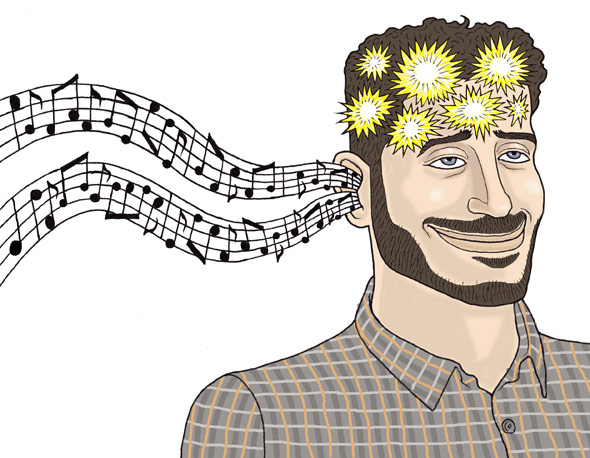
This is your brain in your favorite song

Illustration by Mark Alan Stamaty.
Illustration by Mark Alan Stamaty

When people listen to music they enjoy, their brains drift into a resting daydream, regardless of the genre.

Some prefer the twangs of the steel guitar in country, others the soaring arias of opera. Yet despite individual preferences, people’s favorite tunes generate strikingly similar brain activity patterns and can even enhance their creative ability, according to new research.

We already know that emotional connections to music can be strong, but exactly how favorite melodies influence brain patterns is an ongoing area of discovery.

The researchers scanned the brains of 21 young adults using an MRI machine while piping in music recordings. Each person listened to a genre they liked, one they disliked and their favorite song. 
By separating out the patterns that were related to the music’s beat or lyrics, the researchers found the underlying changes in brain activity related to enjoying a favorite song.
A person's preferred music enhances connections between different regions of the brain, a pattern called the default mode network (DMN), the researchers report. This network is associated with introspection, self-awareness, mind-wandering and possibly imagination. 
When the DMN is activated, another network, the task-positive network (TPN)—which is involved in goal-oriented activity—is shut down. The two states can be thought of as focus on the outside world (the TPN) and focus on inner thoughts (the DMN). Earlier this month, another research group figured out how to switch between these two modes in mice. 
Certain brain disorders seem to involve trouble with activating one mode or another or with switching between the two. For example, since people with autism seem to have problems with DMN activity, the new study’s authors suggest that music therapy may help.
More work needs to be done to investigate the connection between music and mental states before we know if music can help people with autism, but for now, know that the frisson of happy feelings you get when you listen to your favorite song has basis in biology.
Info from: Smithsonian.com

segunda-feira, 18 de agosto de 2014

How Repetition Enchants the Brain and the Psychology of Why We Love It in Music

“Music takes place in time, but repetition beguilingly makes it knowable in the way of something outside of time.”

“The repetition itself becomes the important thing; it’s a form of mesmerism,” Haruki Murakami reflected on the power of a daily routine.“Rhythm is one of the most powerful of pleasures, and when we feel a pleasurable rhythm we hope it will continue,” Mary Oliver about the secret of great poetry, adding: “When it does, it grows sweeter.” But nowhere does rhythmic repetition mesmerize us more powerfully than in music, with its singular way of enchanting the brain.


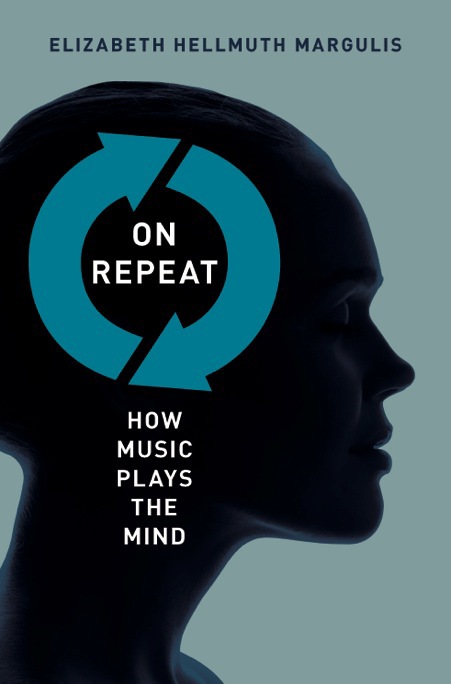
How and why this happens is precisely what cognitive scientist Elizabeth Hellmuth Margulis, director of the Music Cognition Lab at the University of Arkansas, explores in On Repeat: How Music Plays the Mind(public library). This illuminating short animation from TED Ed, based on Margulis’s work, explains the psychology of the “mere exposure effect,” which makes things grow sweeter simply as they become familiar — a parallel manifestation of the same psychological phenomenon that causes us to rate familiar statements as more likely to be true than unfamiliar ones.

Margulis writes:
"Music takes place in time, but repetition beguilingly makes it knowable in the way of something outside of time. It enables us to “look” at a passage as a whole, even while it’s progressing moment by moment. But this changed perspective brought by repetition doesn’t feel like holding a score and looking at a passage’s notation as it progresses. Rather, it feels like a different way of inhabiting a passage — a different kind of orientation."

In On Repeat, a fine addition to these essential books on the psychology of music, Margulis goes on to explore how advances in cognitive science have radically changed our understanding of just why repetition is so psychoemotionally enticing.


Info from Brain Pickings

terça-feira, 22 de julho de 2014

Seven Ways That Music Benefits Your Health - part II

Lets see the effect music can have on a physical/ mental and psychological level. Take a look at the first part of this post here;

4) Makes you Happier
Music affects our emotional state, making you feel happy, ecstatic or even sad. According to a study, your brain releases dopamine, a feel-good chemical, when you listen to tunes that move you. Sometimes you also experience feeling of shivers or chills while listening to a particular track, this shows that brain releases large amount of dopamine, that gives you happiness and pleasure. So listening to music gives us the same hit of happiness that we would get from a piece of chocolate, sex or drugs.

While another study shows that Music with a quick tempo in a major key, brought about all the physical changes associated with happiness in listeners. In contrast, a slow tempo and minor key led to sadness.


Even when we listen to happy music with the intention to feel happy, it always works as opposed to simply listening to music without attempting to alter our mood.

5) Boosts your immune system and reduce Pain
Music has been found to reduce the levels of stress hormone, cortisol, which can weaken the immune system and is responsible for many illnesses. If you like to dance to uplifting music, then you are definitely on a path to better health. Scientists found that after listening to just 50 minutes of uplifting dance music, the levels of antibodies in participants’ bodies increased.

Different types of music might have different effect, but it also depends on your personal preference and what tunes resonate with your soul. What resonates with the spirit, does have a healing effect.

6) Reduces Depression and Anxiety
Listening to music has much more effect on the human mind and psyche. Researchers say that it can helpease anxiety among cancer patients, have positive effects on their mood, pain and improve quality of life. Researchers from Drexel University found that cancer patients who either listened to music or worked with a music therapist experienced a reduction in anxiety, had better blood pressure levels and improved moods.

7) Keeps an aging brain healthy
Having musical training could help keep the brain healthy as people grow older. Any kind of musical activity in life serves as a challenging cognitive exercise, making your brain sharper and more capable of dealing with challenges of aging.

Even someone with brain damage or dementia can recover memories through listening to music. It is ingrained in our deepest core of being, no matter the language, the sound and the rhythm resonates deep within. Like Kahlil Gibran puts it, “Music is the language of the spirit. It opens the secret of life bringing peace, abolishing strife.”

Info from The Mind Unleashed