Um espaço para partilha de ideias relacionadas com as práticas artísticas
e os seus efeitos terapêuticos, com destaque para a vertente musical

quinta-feira, 26 de abril de 2012

Helping Children Heal Through Art Therapy

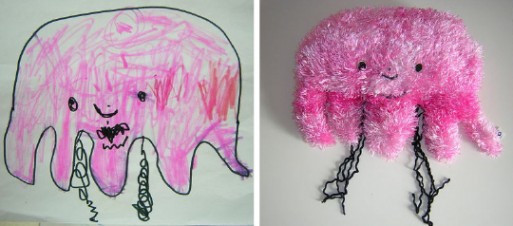
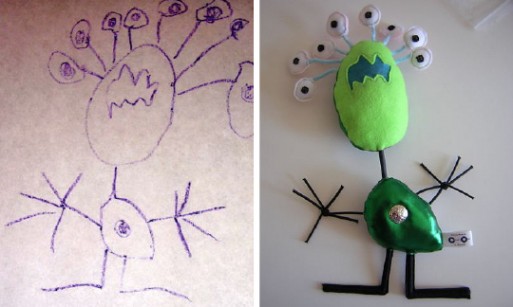
Custom-made Stuffed Toys "Stuffies" Help Children Express Their Emotions -- and Bring Their Creations to Life. Child's Own Studio began with a simple gift for a 4-year-old boy and bloomed into a full-fledged craft business, which has made hundreds of unique “softies” – stuffed toys for children based on their own drawings.

Child’s Own works to celebrate a child’s imagination by building handcrafted one-of-a-kind soft toys, each created by the individual imagination of a child. Several craft businesses around the country have developed to create similar collaborative art with children.

Although softies (sometimes also called “stuffies”) can be made for a number of reasons – encouraging creativity, sparking imagination, offering comfort, building a keepsake – the craft has great potential to help children cope with life-threatening illnesses, or to heal through grief. Art therapy can be a fantastic way for young children to express how they are feeling when dealing with the stress and pain of illness or loss, and softies take that therapy a step further – by creating a comforting toy or keepsake out of a child’s therapeutic artwork.

Since softies are one hundred percent unique – each one custom-made for a single child – you can let your imagination take charge, including elements that help your child best. Softies can be made from the fabric of the old clothes of a loved one, or perhaps a comforting blanket that your child has grown out of. They can include materials that have special meaning to your child, to create something that will comfort them in hard times, while bringing their unique creation to life.


Info by Dana Sitar at Seven Ponds

segunda-feira, 16 de abril de 2012

Stress Relief Using Art Therapy


In recent years there has been much written about the healing benefits of art therapy, and serious illnesses involving stress. Once considered a useless waste of time, art therapy is making headlines with its undeniable success rates among individuals suffering from various disorders. However, anyone dealing with varying degrees of stress can benefit from art therapy.

How does art therapy work?

  • Experimenting with art in all its different forms allows you to express your feelings. For some people this is an easy project, but for those who keep their feelings suppressed, and hidden from everyone including themselves, it is far more difficult. Re-establishing connections to the inner workings of your heart is essential to living a low stress existence.
  • Releasing pent up anger can change your mood and lower stress levels. Using art is a wonderful way to pour out your feelings without the burden of finding words to represent them.
  • Art allows you to rediscover your inner child. Remember what it was like to not have to colour inside the lines? Or when the sky could be green and pigs purple? No? Well you are not alone. Most adults feel compelled to follow a list of rules that only undermine the essential components of creativity. Maturing and settling into responsibility may be a necessary part of growing up, but there are certain privileges children have that we could all benefit from. The freedom to express ourselves using art is one of them. Toss aside the rules and simply create. You might be surprised with what you see.
  • Working with clay and other physical, hands on art mediums maximizes the pressure points of the hands that naturally aide in the release of stress.
  • You can lose yourself in art projects. Let the troubles of the world fall away as your mind refocuses on the beauty and wonder of colour and texture. Art allows to us let go of the constraints that bind us to the conformity of the world for a moment in time.
  • It is easy to allow the pressures of our day consume us. Art allows us to reflect inward and relearn something about ourselves we might have forgotten. Even if you are the kind of person who feels intimidated by creativity it is worth the personal stretch of trying something new. Pick up a paintbrush and start dabbling with colour. What do you see? Take a pottery class and immerse yourself in the mess and chaos. Try your hand at abstract. Sculpt and design using scraps and materials lying around the house.

Remember: There are no rules! Art therapists believe that art triggers an internal activity within us helping to heal emotional, spiritual, and even physical scars. It is a language without words, and a form of communication open to interpretation. “Art therapy is considered a mind-body intervention that can influence physiological and psychological symptoms. The experience of expressing oneself creatively can reawaken positive emotions and address symptoms of emotional numbing in individuals with PTSD.” – Josée Leclerc, a professor in the Department of Creative Arts Therapies

Article by Karen Pasqualucci @ Ezine Articles


segunda-feira, 26 de março de 2012

How art benefits the brain

by Grant Eckert

Many people question the purpose of art. They acknowledge an aesthetic approach but ignore any possible positive benefits of a more practical nature. Contrary to popular belief, art is not purely aesthetic. It is not a product with no possible effects outside of the obvious - an "artistic" product. Art is not of less use than science in preparing individuals for the "real" world. In fact, the contrary is true. Art is very important in helping the brain reach its full potential.

How does art accomplish this? It introduces the brain to diverse cognitive skills that help us unravel intricate problems. Art activates the creative part of our brain - the part that works without words and can only express itself non-verbally. Art, in thought and through the creative processes, activates the imaginative and creative side, the spatial and intuitive side of our brain. Art jumps over the process of linear and logical thinking. It trains the brain to shift into thinking differently, of broaching old problems in new ways. This is what makes art so important. It benefits the brain by training it to think outside the box. It helps children understand concepts with greater ease. It aids children in getting better grades. In the real world, the artistic side of the brain helps engineers solve problems. It guides individuals to create solutions. Art is the property of fine artists; it is also the product of engineers, technicians and computer designers. Art, in many different ways, helps people make the world a better place.

There have been copious studies on the relationship between art and its benefits to the brain. Semir Zeki, a former professor of neurobiology at the University College, London and co-head of the Wellcome Department of Cognitive Neurology, published an article, "Artistic Creativity and the Brain," in Science Magazine, in July 2001. Zeki detailed the relationship between the development of cognitive abilities and the creative process. He stated artistic expression is the key to comprehending ourselves. He also considered art and its expression as an expansion of brain function. In other words, art helps the brain in its search for knowledge.

Teachers apply this in the classroom, helping children improve their cognitive capabilities and stretch their ability to solve difficult problems. Professional therapists have also embraced art as another tool in their arsenal of leading the brain-weary back to health. In fact, several psychiatrists and psychologists highly recommend this form of treatment. Furthermore, training is now in place to ensure the standards remain high in this developing field.

Art therapy is now a common means of helping individuals to improve and enhance the physical, mental and emotional well-being. It bases its approach on the belief that the creative process involved in artistic self-expression helps people in a number of different positive ways. It facilitates them in ending or finding a solution to various conflicts and problems. Art also aids them to manage their behavior, develop interpersonal skills, increase self-esteem and self-awareness, lessen stress and attain insight.

Professionals use art therapy with children, adults and teens, individuals and groups. It is employed regardless of age or gender. Combining the areas of human development, visual arts such as painting, drawing and sculpture, and the creative process with the various models of counseling and psychotherapy, art therapy assesses and treats the following mental problems and disorders: anxiety, depression, mental illness, substance abuse and other addictions. Art therapists address family and relationship issues, abuse and domestic violence and social and emotional difficulties related to disability and illness. Art therapy is applicable in situations of trauma and loss, physical, cognitive, and neurological problems and psychosocial difficulties related to medical illness.

So what are the benefits of art on the brain? When individuals create art and reflect on it, the processes, increase self-awareness, initiate awareness of others and help people cope with stress, and traumatic experiences. Art enhances cognitive abilities and provides individuals with the ability to enjoy the life-affirming pleasures of making art. This is what makes art so important.


sexta-feira, 9 de março de 2012

The Healing Power of Music

"An unconventional approach to recovery and coping, music therapy is a field of medicine capturing new attention due to its role in helping Gabrielle Giffords recover from a gunshot. Correspondent Spencer Michels reports on the versatility of music in a medical setting, but the difficulty of quantifying its effectiveness."


Watch The Healing Power of Music on PBS. See more from PBS NewsHour.


Info acceed at PBS NewsHour
Image at http://ingridking.com/wp-content/uploads/2010/01/kliban_music_cat.jpg


quinta-feira, 8 de março de 2012

3º Encontro Internacional Saúde com Arte

O EISA, Encontro Internacional Saúde com Arte, é um espaço de reflexão e formação em torno do papel terapêutico que a Arte em geral, e a Música muito em particular, têm para o Ser Humano.

Promovido pela SAMP – Sociedade Artística Musical dos Pousos, coloca o ambiente hospitalar e a primeira infância como eixos prioritários de intervenção, abrindo-se contudo a outras populações alvo dos programas SAMP, como os idosos, doentes mentais e reclusos.

Depois de abordagens aos projetos Europeus mais significativos de música em ambiente hospitalar nas edições anteriores, em 2012 a SAMP abre as portas às experiências mais consolidadas nos Estados Unidos, com a presença do Serviço de Música e Medicina do Departamento de Cirurgia do Hospital de Massachusetts em Boston. Também dos EUA, da Northwestern University, estará representado o trabalho de um dos mais prestigiados laboratórios de Neurociência auditiva. O encontro decorrerá a 29 e 30 Março, em Leiria (Pousos) e terá como temática Sinapses e Emoções do Som. Porquê a música?

O EISA é dirigido a todos os profissionais com interesse pela relação Arte e Saúde. Inicialmente concebido para os profissionais SAMP envolvidos em programas de âmbito terapêutico, o EISA tem hoje como destinatários artistas e profissionais de saúde, educadores e professores de ensino especial, médicos, músicos, enfermeiros, assistentes sociais e animadores socioculturais. Está igualmente aberto a estudantes de qualquer uma das áreas anteriores.


segunda-feira, 13 de fevereiro de 2012

Music therapy is making breakthroughs

Machover, an intriguing futurologist as well as an inventive composer, runs the departments in hyper-instruments (acoustical instruments given spiffy electronic features) and opera of the future at MIT's ultra-high-tech Media Lab. Last week, he was at UC Santa Barbara to speak on "Music, Mind and Health: Diagnosis, Treatment, and Well-being through Active Sound," one of four lectures he's given recently at the university's Sage Center for the Study of the Mind.

Music, Machover said, touches on just about every aspect of cognition. There are theories that music exists to exercise the mind and to help coordinate its separate functions. Music lovers intuitively know what researchers have verified, that music modulates our moods, helps us move, stimulates our language skills, strengthens our memories and can wondrously bring about emotional responses without their bothersome consequences.

The practical applications of music for healing are irresistible. Cutting-edge music therapy can help Parkinson's patients walk, enables the autistic to rehearse their emotions and provides opportunities for stroke victims to regain speech and motor movement. Music is usually the last thing Alzheimer's sufferers recognize. It is our final way to communicate with them, and now it seems music can play a significant role in forestalling Alzheimer's.


But that's not all. In an inspiring feedback loop, Machover and his MIT minions, which include some of the nation's most forward-looking graduate students, are applying their musical gadgets to therapy. The process of making remarkable restorative advances is changing how they think about and make music.

And that could affect how the rest of us might think about and make music in the not-so-distant future.It all began with Hyperscore, a program Machover developed to enable children to compose by drawing and painting on a monitor. A sophisticated computer program translates their artwork into a musical score.

Machover's team took Hyperscore to Tewksbury Hospital outside of Boston, which serves patients with severe physical and mental disabilities, and also includes the homeless. The residents, many of whom were physically unable to communicate or were otherwise uncommunicative, discovered their inner composer. Through Hyperscore they found they could express themselves in a way that bypassed language.

A few patients with hopeless prognoses and no meaningful life had significant enough changes in their pathology that they could actually think about at least partial recovery. Some found a decrease in auditory and visual hallucinations. There were behavior changes in many that allowed for socialization.

Dan Ellsey became the model patient. Born with cerebral palsy and unable to speak, he was forced to communicate with a headset that pointed to letters to spell out words. He had little control of his body movements. He was in his early 30s, had never been more than five miles from where he was born and seemed doomed to spend a cocooned life in the hospital.The Media Lab scientists designed a more refined headset for Ellsey that not only inspired him to compose (he turned out to have interesting musical ideas) but even allowed him to perform by controlling tempo, loudness and articulation. He blossomed, and Ellsey, while still a severely affected cerebral palsy patient, has become an active participant in the Hyperscore program, performing, making CDs and teaching other patients. He was a star at the 2008 TED conference.

What this work with music therapy has shown Machover and other researchers is the potential for what he has dubbed "personal" music. This will be a music tailored to an individual's needs, be it medicinal or simply a matter of taste.Traditionally what a composer has done, Machover explains, is to create a piece that will reach the largest number of people. But as our knowledge of how music affects our bodies and minds grows, the opportunity will arise when a piece of music can be designed specifically for your life experiences, needs and moods. A piece can even be made to change over time as you change.

Info at Los Angeles Times

Image at: http://t0.gstatic.com/images?q=tbn:ANd9GcReia34NSzU_A80W-j14mazc8ANb6DPWhCxU3nwjxHK3CNPXUGf


quarta-feira, 1 de fevereiro de 2012

Music Training Has Biological Impact on Aging Process

By Wendy Leopold

Age-related delays in neural timing are not inevitable and can be avoided or offset with musical training, according to a new study from Northwestern University. The study is the first to provide biological evidence that lifelong musical experience has an impact on the aging process.
Measuring the automatic brain responses of younger and older musicians and non-musicians to speech sounds, researchers in the Auditory Neuroscience Laboratory discovered that older musicians had a distinct neural timing advantage.

“The older musicians not only outperformed their older non-musician counterparts, they encoded the sound stimuli as quickly and accurately as the younger non-musicians,” said Northwestern neuroscientist Nina Kraus. “This reinforces the idea that how we actively experience sound over the course of our lives has a profound effect on how our nervous system functions.” Kraus, professor of communication sciences in the School of Communication and professor of neurobiology and physiology in the Weinberg College of Arts and Sciences, is co-author of “Musical experience offsets age-related delays in neural timing” published online in the journal “Neurobiology of Aging.”

“These are very interesting and important findings,” said Don Caspary, a nationally known researcher on age-related hearing loss at Southern Illinois University School of Medicine. “They support the idea that the brain can be trained to overcome, in part, some age-related hearing loss.”

“The new Northwestern data, with recent animal data from Michael Merzenich and his colleagues at University of California, San Francisco, strongly suggest that intensive training even late in life could improve speech processing in older adults and, as a result, improve their ability to communicate in complex, noisy acoustic environments,” Caspary added.

Previous studies from Kraus’ Auditory Neuroscience Laboratory suggest that musical training also offset losses in memory and difficulties hearing speech in noise -- two common complaints of older adults. The lab has been extensively studying the effects of musical experience on brain plasticity across the life span in normal and clinical populations, and in educational settings.

However, Kraus warns that the current study’s findings were not pervasive and do not demonstrate that musician’s have a neural timing advantage in every neural response to sound. “Instead, this study showed that musical experience selectively affected the timing of sound elements that are important in distinguishing one consonant from another.”

The automatic neural responses to speech sounds delivered to 87 normal-hearing, native English-speaking adults were measured as they watched a captioned video. “Musician” participants began musical training before age 9 and engaged consistently in musical activities through their lives, while “non-musicians” had three years or less of musical training.

Info at NorthWestern University
Image at https://www.stanford.edu/group/smblogs/cgi-bin/scope/wp-content/uploads/2012/01/playing_piano_01312.jpg