Um espaço para partilha de ideias relacionadas com as práticas artísticas
e os seus efeitos terapêuticos, com destaque para a vertente musical

Mostrando postagens com marcador singing. Mostrar todas as postagens

quarta-feira, 12 de agosto de 2015

How music acts as medicine for the soul

Henry, an elderly man living in a US nursing home and largely unresponsive to the outside world, receives a pair of headphones to listen to his favourite artist, Cab Calloway .

The neurologist Dr Oliver Sacks, who's involved with the project, describes Henry as "almost unalive", but as soon as the music starts there's a complete transformation. He starts moving and singing along, becoming animated. "The philosopher Kant once called music the 'quickening art' and Henry has been 'quickened' – he's been brought to life," Sacks says in the video.


But the effect doesn't stop once the music is turned off. Though he's normally unable to answer the simplest questions, Henry now starts speaking about his love for music, how it makes him feel, and singing I'll Be Home for Christmas, remembering every single word of the lyrics. It's almost magical.

There's a charity here in the UK that knows all about how music can transform the lives of those who suffer from autism, dementia, and a whole range of mental health problems. The work of the founders of Nordoff Robbins – Paul Nordoff, an American composer and pianist, and Clive Robbins, a special education teacher – began more than half a century ago, as they used music therapy to help isolated and disabled children. In 1980 the charity bearing their names was established in the UK.

Nordoff and Robbins discovered music's power to open up the senses and "reawaken" people with dementia doesn't only come from the familiarity of favourite songs. In a mesmerising video, one of the charity's music therapists starts communicating with a woman whose dementia has lead to the loss of speech, by doing a sort of singing and guitar-playing call-and-response. In another one, Jack, an autistic boy with severe learning difficulties, lights up and starts to communicate not only by singing, but with his whole body.


But music can also have a calming and healing effect on those with mental illnesses. Nordoff Robbins works with Lance, who lives with schizophrenia and says music therapy makes him "feel more human again" and is "a haven from intrusive bad thoughts and depression".

The charity provides music therapy at his local centre for people with mental health problems, where he plays guitar, often supporting other people's songs. "I feel that music is holding my hand through all this," he explains.

The therapists who go into schools, hospitals, care homes and prisons, help people communicate where words have failed, raising their confidence, self-esteem and sense of joy through music, one of the most powerful remedies that can't be bought from pharmaceutical companies. Music is medicine for the soul.

Info from The Guardian


domingo, 25 de maio de 2014

APCC vence Festival Europeu da Canção - vídeo


A Associação de Paralisia Cerebral de Coimbra venceu o Festival Europeu da Canção para pessoas com deficiência, em Estocolmo, no dia 2 de Maio de 2014.

Músicos: Paulo Jesus, Pedro Falcão, Paulo Casal e Márcio Reis. 

Diretor artístico: Paulo Jacob. 

Chefe da delegação portuguesa: Rui Ramos, ARCIL (Associação para a Recuperação de Cidadãos Inadaptados da Lousã).

domingo, 18 de maio de 2014

APCC vence Festival Europeu da Canção

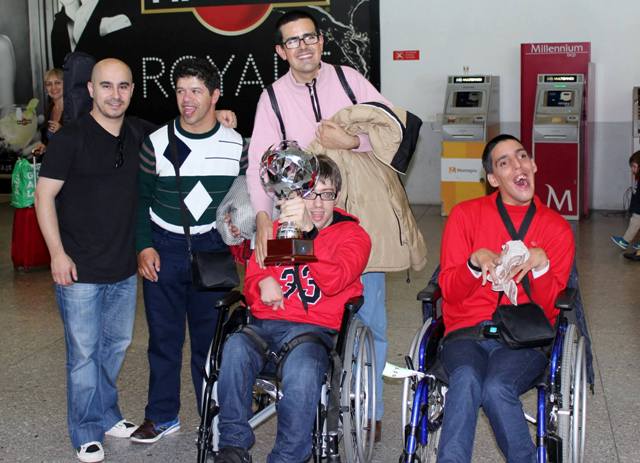
Paulo Jesus, Pedro Falcão, Paulo Casal e Márcio Reis venceram, em 2 de maio de 2014, o Festival Europeu da Canção para a Pessoa com Deficiência Mental. 
Representaram a APCC – Associação de Paralisia Cerebral de Coimbra e Portugal, em Estocolomo, Suécia, depois de terem conquistado, em 20 de outubro de 2012, o Festival Nacional da Canção para Pessoas com Deficiência, na Lousã.

Acompanhados pelo professor Paulo Jacob apresentaram «Mundo de Contradições» que, com letra de Paulo Casal, conquistou o júri e lhes permitiu viver uma experiência memorável. Foi com este mesmo trabalho que Paulo Jesus e Pedro Falcão se estrearam em palco.

Nas palavras de Paulo Jacob foi para todos «uma honra» participar num festival europeu no qual competiram 12 concorrentes. Representaram a instituição e um país que, segundo disse o apresentador do festival, tem uma «língua exótica, suave e agradável».

Os colaboradores da APCC receberam, em 4 de maio, estes vencedores que chegaram a Portugal visivelmente felizes e orgulhosos por todo o trabalho desenvolvido.

Foi a segunda vez que a APCC venceu o Festival Europeu da Canção. Este é, aliás, o segundo título conquistado por Márcio Reis, pois em 2005, e acompanhado por Rita Joana, sagrou-se vencedor, em Áustria, com «Maior que o Mundo».

PARABÉNS!


Notícia de APC_Coimbra

sexta-feira, 15 de novembro de 2013

How Music Can Reach the Silenced Brain

Words Spoken And Sung
There are several cases in which a patient has recovered speech through the systematic use of rhythmic patterning, leading first to recovery of familiar lyrics and words embedded in songs, then to self-initiation of normal, fluent speech.Image courtesy of Concetta M. Tomaino
Because music has parallels to spoken language, much research on music and the brain has zeroed in on the similarities and differences between them. The similarities could be clues to more successful methods of using musical cueing to stimulate similar language responses in people with brain injuries. One remarkable example of the functional difference between music and language, however, occurs in people who have suffered a left-side stroke, resulting in a type of aphasia where verbal comprehension still exists but the ability to speak or find the right words is lost. In these cases, the brain lesion is often located in what is called Broca’s area; speech is slow, not fluent, and hesitant, with great difficulties in articulation.  Yet, despite the loss of speech, many people with this type of aphasia can sing complete lyrics to familiar songs. This has usually been attributed to the separation of function of the left and right hemispheres of the brain, speech being dominant on the left and singing on the right.
Because many clinicians assume a complete separation of function between singing and speaking, they give little attention to the potential for using music to aid speech. But there are several cases in which a patient has recovered speech through the systematic use of rhythmic patterning, leading first to recovery of familiar lyrics and words embedded in songs, then to self-initiation of normal, fluent speech. In each case, however, this remarkable change had been attributed not to the music but to spontaneous recovery during the early months after the stroke.
A similarity shared by music and speech is what we call “prosody,” which includes the elements of stress, pitch direction, pitch height, and intonation contour, or inflection. People with nonfluent aphasia can perform a type of prosodic speech that includes the inflection and contour of previously known phrases. This speech differs, however, from propositional speech (which includes verbal expression of new thoughts and ideas) in its rate, discrete pitch, and increased predictability. Aniruddh D. Patel, Ph.D., a scientist at the Neurosciences Institute in California, theorizes that rhythm and song, which are inherently predictable, may create a “supra-linguistic” structure that helps cue what is coming next in an utterance.
Brain-imaging studies by Dr. Pascal Berlin, of the Service Hospitalier Frederic Joliot in France, and more recently by Dr. Burkhard Maess at the Max Planck Institute of Cognitive Neuroscience, used PET and MEG scans to determine that areas peripheral to the left language regions of the brain are involved in processing the singing of single words. Additional imaging studies suggest that some aspects of music and language are processed in both the right and left sides of the brain. In many patients who are able to carry over speech techniques from music, success seems to come from their increased ability to attend to sounds and to initiate them, perhaps because parallel mechanisms for these functions have been called into play by music and singing.