Um espaço para partilha de ideias relacionadas com as práticas artísticas
e os seus efeitos terapêuticos, com destaque para a vertente musical

Mostrando postagens com marcador songs. Mostrar todas as postagens

domingo, 4 de outubro de 2015

Jamming With Your Toddler: How Music Trumps Reading For Childhood Development - part I

Forget the Mozart Effect and Baby Einstein, take it easy on acquisitions for your two-year-old’s private library, and don’t fret if your three-year-old hasn’t started violin lessons just yet.

The key to unlocking a child’s potential intelligence and happiness may indeed lie in music, but succumbing to the commercial juggernaut that is the baby-genius-making industry may not be in either your child or your wallet’s best interest. Instead, try making up songs with your toddler. 


A new study suggests that regular informal music-making with very young children may even have benefits above and beyond those of reading. But there’s an important, interesting, and somewhat beautiful catch – for best results, make it shared music-making in your home.

In an analysis of data generated from a study involving more than 3,000 children, a University of Queensland team investigated the associations between informal home music education for very young children and later cognitive and social-emotional outcomes.
The team found that informal music-making in the home from around the ages of two and three can lead to better literacy, numeracy, social skills, and attention and emotion regulation by the age of five.
By measuring the impact of music and reading both separately and in combined samples, the researchers were able to identify benefits from informal music activity over and above shared book reading, most strongly in relation to positive social behaviour, attention regulation and to a lesser but still significant extent, numeracy.

Part of an Australian Research Council funded study titled “Being and becoming musical: towards a cultural ecological model of early musical development”, the study aims to provide a comprehensive account of how Australian families use music in their parenting practices and make recommendations for policy and practice in childcare and early learning and development.

Last month, the team was awarded the inaugural Music Trust Award for Research into the Benefits of Music Education.

Science has shown that music’s effect on the brain is particularly strong, with studies demonstrating an improvement in IQ among students who receive music lessons. Advantages in the classroom have been identified for students who study musical instruments, and the effects of ageing on cognition may even be mitigated through lifelong musical activity.


Info from IFLScience

quarta-feira, 1 de outubro de 2014

Lullabies reduce pain in children, say academics

A study at Great Ormond Street Hospital suggests lullabies do more than just help babies sleep – they reduce pain in sick children

Parents should sing to their children when they hurt themselves as lullabies help to reduce their pain, a study has found. 

Singing Twinkle Twinkle Little Star, Hushabye Baby and Five Little Ducks to sick children was found to alleviate their suffering by researchers at London’s Great Ormond Street Hospital. 

They sang the songs to a group of children under three, some of whom were waiting for heart transplants, and monitored their heart rates and pain perception. 

The scientists then compared this with two other groups, one in which the children had been read to and the other where they had been left alone, and found only those who had been sung to showed a reduction in pain or heart rate.


Professor David Hargreaves of Roehampton University, one of the study’s authors, said the results went further than many parents' intuitive sense that singing lullabies calms children.

"It shows that children can be affected physiologically by music," he said.

He underlined that the research was still in the early stages, but added: "The practical applications are fairly obvious. Music therapists are going to be a lot cheaper than drugs to numb pain."

Professor Tim Griffiths, a consultant neurologist with the Wellcome Trust, told BBC Radio 4's Today programme: “There’s an ancient part of the brain in the limbic system which is responsible for the emotional responses to music.

"What I think is happening here is that the emotional part of the brain is being stimulated by music, more so than the reading stimulus," he said of the study at the London children’s hospital.

“This is decreasing the arousal level, and that in turn is affecting their pain response levels.”

The songs researchers used to reduce pain:
  • Hush Little Baby
  • Hushabye Baby
  • See Saw Margery Daw
  • Donkey Riding
  • Little Fish
  • Twinkle Twinkle
  • Five Little Ducks

quinta-feira, 25 de setembro de 2014

This is your brain in your favorite song

Illustration by Mark Alan Stamaty.
Illustration by Mark Alan Stamaty

When people listen to music they enjoy, their brains drift into a resting daydream, regardless of the genre.

Some prefer the twangs of the steel guitar in country, others the soaring arias of opera. Yet despite individual preferences, people’s favorite tunes generate strikingly similar brain activity patterns and can even enhance their creative ability, according to new research.

We already know that emotional connections to music can be strong, but exactly how favorite melodies influence brain patterns is an ongoing area of discovery.

The researchers scanned the brains of 21 young adults using an MRI machine while piping in music recordings. Each person listened to a genre they liked, one they disliked and their favorite song. 
By separating out the patterns that were related to the music’s beat or lyrics, the researchers found the underlying changes in brain activity related to enjoying a favorite song.
A person's preferred music enhances connections between different regions of the brain, a pattern called the default mode network (DMN), the researchers report. This network is associated with introspection, self-awareness, mind-wandering and possibly imagination. 
When the DMN is activated, another network, the task-positive network (TPN)—which is involved in goal-oriented activity—is shut down. The two states can be thought of as focus on the outside world (the TPN) and focus on inner thoughts (the DMN). Earlier this month, another research group figured out how to switch between these two modes in mice. 
Certain brain disorders seem to involve trouble with activating one mode or another or with switching between the two. For example, since people with autism seem to have problems with DMN activity, the new study’s authors suggest that music therapy may help.
More work needs to be done to investigate the connection between music and mental states before we know if music can help people with autism, but for now, know that the frisson of happy feelings you get when you listen to your favorite song has basis in biology.
Info from: Smithsonian.com

domingo, 25 de maio de 2014

APCC vence Festival Europeu da Canção - vídeo


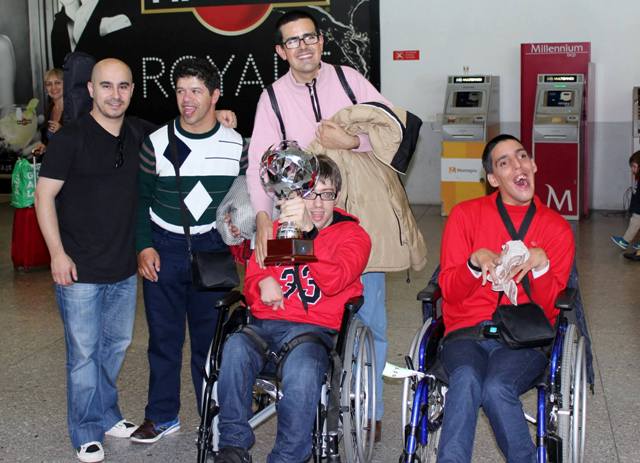
A Associação de Paralisia Cerebral de Coimbra venceu o Festival Europeu da Canção para pessoas com deficiência, em Estocolmo, no dia 2 de Maio de 2014.

Músicos: Paulo Jesus, Pedro Falcão, Paulo Casal e Márcio Reis. 

Diretor artístico: Paulo Jacob. 

Chefe da delegação portuguesa: Rui Ramos, ARCIL (Associação para a Recuperação de Cidadãos Inadaptados da Lousã).

domingo, 18 de maio de 2014

APCC vence Festival Europeu da Canção

Paulo Jesus, Pedro Falcão, Paulo Casal e Márcio Reis venceram, em 2 de maio de 2014, o Festival Europeu da Canção para a Pessoa com Deficiência Mental. 
Representaram a APCC – Associação de Paralisia Cerebral de Coimbra e Portugal, em Estocolomo, Suécia, depois de terem conquistado, em 20 de outubro de 2012, o Festival Nacional da Canção para Pessoas com Deficiência, na Lousã.

Acompanhados pelo professor Paulo Jacob apresentaram «Mundo de Contradições» que, com letra de Paulo Casal, conquistou o júri e lhes permitiu viver uma experiência memorável. Foi com este mesmo trabalho que Paulo Jesus e Pedro Falcão se estrearam em palco.

Nas palavras de Paulo Jacob foi para todos «uma honra» participar num festival europeu no qual competiram 12 concorrentes. Representaram a instituição e um país que, segundo disse o apresentador do festival, tem uma «língua exótica, suave e agradável».

Os colaboradores da APCC receberam, em 4 de maio, estes vencedores que chegaram a Portugal visivelmente felizes e orgulhosos por todo o trabalho desenvolvido.

Foi a segunda vez que a APCC venceu o Festival Europeu da Canção. Este é, aliás, o segundo título conquistado por Márcio Reis, pois em 2005, e acompanhado por Rita Joana, sagrou-se vencedor, em Áustria, com «Maior que o Mundo».

PARABÉNS!


Notícia de APC_Coimbra

sexta-feira, 15 de novembro de 2013

How Music Can Reach the Silenced Brain

Words Spoken And Sung
There are several cases in which a patient has recovered speech through the systematic use of rhythmic patterning, leading first to recovery of familiar lyrics and words embedded in songs, then to self-initiation of normal, fluent speech.Image courtesy of Concetta M. Tomaino
Because music has parallels to spoken language, much research on music and the brain has zeroed in on the similarities and differences between them. The similarities could be clues to more successful methods of using musical cueing to stimulate similar language responses in people with brain injuries. One remarkable example of the functional difference between music and language, however, occurs in people who have suffered a left-side stroke, resulting in a type of aphasia where verbal comprehension still exists but the ability to speak or find the right words is lost. In these cases, the brain lesion is often located in what is called Broca’s area; speech is slow, not fluent, and hesitant, with great difficulties in articulation.  Yet, despite the loss of speech, many people with this type of aphasia can sing complete lyrics to familiar songs. This has usually been attributed to the separation of function of the left and right hemispheres of the brain, speech being dominant on the left and singing on the right.
Because many clinicians assume a complete separation of function between singing and speaking, they give little attention to the potential for using music to aid speech. But there are several cases in which a patient has recovered speech through the systematic use of rhythmic patterning, leading first to recovery of familiar lyrics and words embedded in songs, then to self-initiation of normal, fluent speech. In each case, however, this remarkable change had been attributed not to the music but to spontaneous recovery during the early months after the stroke.
A similarity shared by music and speech is what we call “prosody,” which includes the elements of stress, pitch direction, pitch height, and intonation contour, or inflection. People with nonfluent aphasia can perform a type of prosodic speech that includes the inflection and contour of previously known phrases. This speech differs, however, from propositional speech (which includes verbal expression of new thoughts and ideas) in its rate, discrete pitch, and increased predictability. Aniruddh D. Patel, Ph.D., a scientist at the Neurosciences Institute in California, theorizes that rhythm and song, which are inherently predictable, may create a “supra-linguistic” structure that helps cue what is coming next in an utterance.
Brain-imaging studies by Dr. Pascal Berlin, of the Service Hospitalier Frederic Joliot in France, and more recently by Dr. Burkhard Maess at the Max Planck Institute of Cognitive Neuroscience, used PET and MEG scans to determine that areas peripheral to the left language regions of the brain are involved in processing the singing of single words. Additional imaging studies suggest that some aspects of music and language are processed in both the right and left sides of the brain. In many patients who are able to carry over speech techniques from music, success seems to come from their increased ability to attend to sounds and to initiate them, perhaps because parallel mechanisms for these functions have been called into play by music and singing.